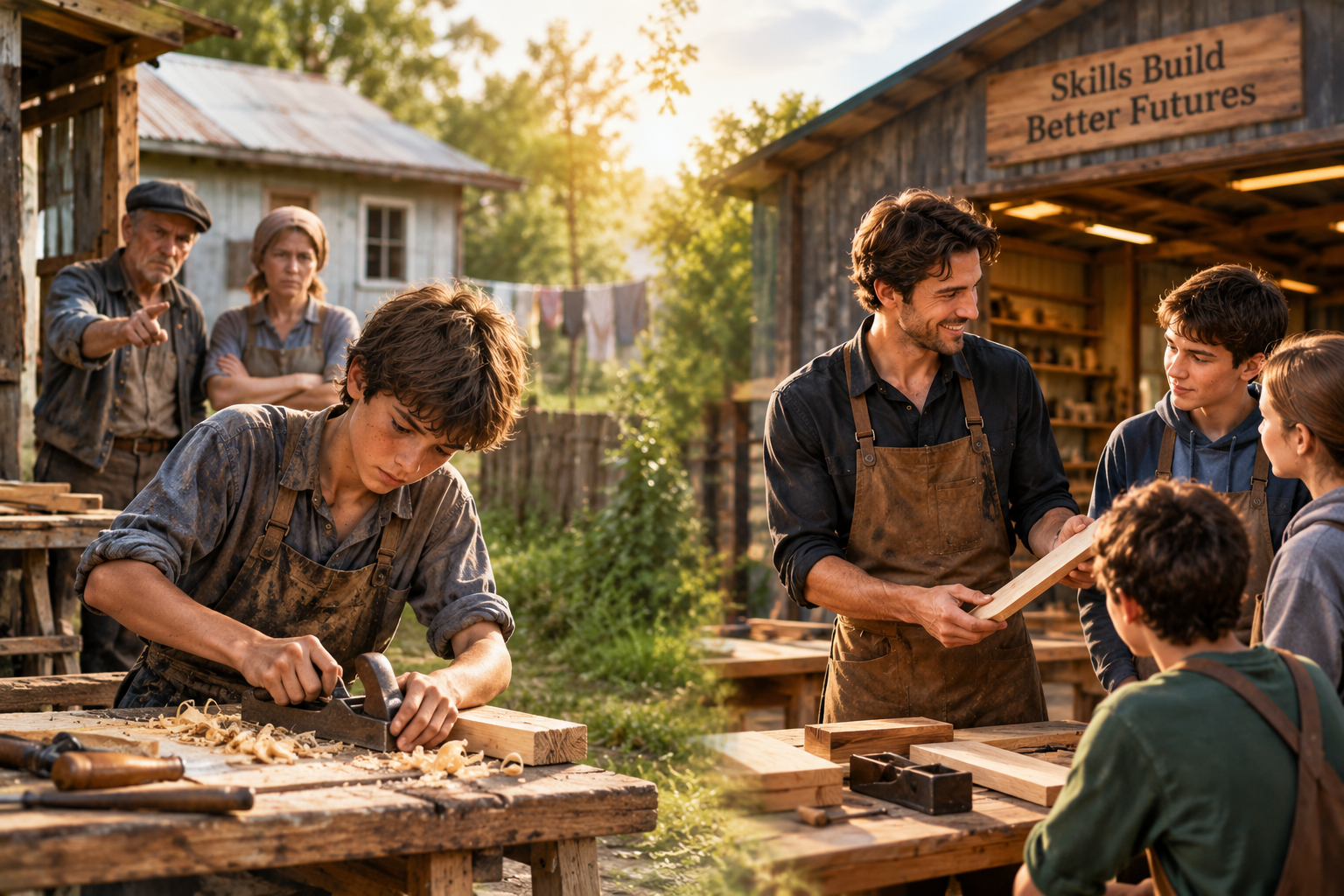
The Boy Everyone Underestimated
Everyone in the village knew Daniel Reed as the boy from the little house at the end of Miller’s Road.
His family had never had much.
His father repaired broken farm tools for a living, and his mother cleaned houses whenever she could find work. Their roof leaked during heavy rain, their kitchen stove was older than Daniel, and there were winters when they had to choose carefully what they could afford.
But Daniel had something his family couldn’t buy.
He had patience.
At fourteen, he discovered an old wooden workbench behind his father’s shed. On it were a handful of worn tools and scraps of wood.
Daniel began making things.
At first, they were simple.
A crooked stool.
A small wooden box.
A shelf that refused to stand straight.
His first attempts were terrible.
His neighbors laughed.
“That’s what you call craftsmanship?”
“You should find a real job.”
“Boys like you don’t become craftsmen.”
Daniel listened.
But he didn’t stop.
The First Lesson
Daniel’s father watched him work one afternoon.
“You’re not very good yet,” he said.
Daniel lowered his head.
His father smiled.
“But being bad at something isn’t the same as being unable to learn it.”
That sentence stayed with Daniel.
Every morning before school, he practiced.
Every afternoon, he practiced again.
He learned how different types of wood behaved.
He studied measurements.
He learned how to sharpen tools.
When something broke, he didn’t throw it away.
He figured out why it broke.
His hands became rough.
His clothes became covered in sawdust.
His classmates spent their afternoons playing football while Daniel stayed behind the shed, practicing the same technique until he could do it without thinking.
The Man Who Said He Would Never Succeed
When Daniel was seventeen, a wealthy furniture maker named Mr. Carson visited the village.
Daniel gathered enough courage to show him a small wooden chair he had made.
Mr. Carson examined it.
Then he laughed.
“This is not craftsmanship.”
Daniel’s face turned red.
“You’re wasting your time,” the man continued. “People from families like yours don’t become successful craftsmen. You need money, connections, and proper training.”
Daniel took the chair back.
He didn’t argue.
He simply said:
“Thank you for looking at it.”
That evening, Daniel sat alone behind the shed.
For the first time, he wondered if everyone had been right.
His mother found him there.
“You’re quiet.”
“Maybe they’re right.”
She sat beside him.
“Who?”
“Everyone.”
His mother looked at the unfinished chair.
“Everyone has an opinion about a road they aren’t walking.”
Daniel smiled faintly.
Then she said something he would remember for the rest of his life.
“If you love the work, let the work answer them.”
The Years Nobody Saw
Daniel left school at eighteen and found work in a small workshop in the city.
The pay was terrible.
The hours were long.
For the first two years, he mostly swept floors, carried materials, and cleaned tools.
Several employees laughed when they learned he had no formal training.
Daniel didn’t complain.
He watched.
He listened.
He practiced.
Whenever the workshop closed, he stayed behind and worked on unfinished pieces.
His hands became faster.
His measurements became more precise.
His understanding of materials became deeper.
Years passed.
People who had once laughed at him stopped laughing.
Then something unexpected happened.
The workshop owner asked Daniel to design a dining table for an important client.
Daniel spent three weeks on it.
When the table was finished, the client stood silently beside it.
Then he ran his hand across the surface.
“Who made this?”
“Daniel.”
The client nodded.
“I want him to make the rest of the furniture.”
It was Daniel’s first major opportunity.
He didn’t waste it.
The Secret Behind His Success
Daniel’s success didn’t happen overnight.
There were no shortcuts.
He failed hundreds of times.
He ruined expensive materials.
He lost customers.
He made mistakes.
But each mistake became another lesson.
Eventually, Daniel opened his own workshop.
Then another.
Then another.
His furniture became known for its quality.
People traveled from other towns to buy his work.
Magazines began writing about him.
The same young man who had once been told he would never succeed was now employing dozens of people.
But Daniel never forgot where he came from.
The Return Home
Twenty years after leaving the village, Daniel returned.
He drove past the old houses and recognized Miller’s Road immediately.
His family’s house looked smaller.
The roof had finally been repaired.
The old shed was still standing.
Daniel walked toward it.
His father was sitting on the porch.
For a moment, neither spoke.
Then his father smiled.
“You came home.”
Daniel nodded.
“I did.”
His father looked toward the old shed.
“Still making things?”
Daniel laughed.
“Every day.”
The People Who Once Doubted Him
The next morning, Daniel walked through the village.
He saw Mr. Carson sitting outside his old furniture shop.
The man was much older now.
His business had closed years earlier.
Mr. Carson recognized Daniel.
“You’re that boy.”
Daniel smiled.
“Yes.”
Mr. Carson looked at him carefully.
“I heard you became successful.”
“I’ve been fortunate.”
Mr. Carson lowered his eyes.
“I was wrong about you.”
Daniel could have reminded him of every cruel word.
He could have told him how many nights he had doubted himself because of that conversation.
Instead, Daniel simply said:
“We were both younger then.”
Mr. Carson looked surprised.
Then Daniel offered him a job teaching apprentices at his new workshop.
The old man stared at him.
“After what I said?”
Daniel nodded.
“Everyone deserves a chance to learn something new.”
Giving Back
Daniel’s real reason for returning home wasn’t to prove anyone wrong.
He wanted to build something that would last.
He purchased the abandoned community workshop and transformed it into a free training center for young people from struggling families.
Students learned woodworking, metalworking, repair, design, and other practical skills.
No one was asked where they came from.
Daniel cared about one thing:
Were they willing to learn?
One afternoon, a teenage boy stood nervously in front of Daniel.
“I don’t think I’m good enough.”
Daniel recognized the expression immediately.
It was the same doubt he had once carried.
Daniel handed him a piece of wood.
“Neither was I.”
The boy looked confused.
Daniel smiled.
“That’s why you practice.
The Craft That Changed Everything
Years later, Daniel stood inside the workshop he had built in his hometown.
The walls were covered with photographs of students who had gone on to become builders, designers, mechanics, and skilled tradespeople.
His father sat near the window, watching.
“You’ve done well,” he said.
Daniel looked around.
“I didn’t do it alone.”
His father smiled.
“You did the work.”
Daniel shook his head.
“You taught me the first lesson.”
“What lesson?”
Daniel smiled.
“That being bad at something isn’t the same as being unable to learn it.”
His father laughed.
“I said that?”
“You did.”
Outside, several young students were carrying pieces of timber into the workshop.
Daniel watched them.
He remembered the boy he had been.
Poor.
Uncertain.
Ridiculed.
But determined.
He finally understood something important.
The people who doubted him had never been his greatest obstacle.
His greatest obstacle had been believing them.
Once he stopped listening to those voices and started listening to the quiet voice inside himself, everything changed.
The Real Measure of Success
Daniel never became successful because he proved his critics wrong.
He became successful because he refused to stop learning.
And when he finally had everything he once dreamed of, he discovered something even more valuable than money.
He could give someone else the opportunity he had once needed.
A chance.
A teacher.
A workshop.
A little encouragement.
Sometimes, that is all a person needs to change the direction of their life.
Daniel had started with almost nothing.
But through discipline, patience, and years of mastering his craft, he built more than a successful career.
He built a legacy.
And every time a young person walked through the doors of his workshop believing they could become something more, Daniel knew the work was worth it.